Wednesday, June 7, 2017

Paying Homage

At the end of the first act of Alan Bennett's masterful play, The History Boys, Hector, an unusual teacher of literature is inspired by a comment by Posner, a delicate student of his, to say the following:
The best moments in reading are when you come across something-- a thought, a feeling, a way of looking at things--which you had thought special and particular to you.  Now here it is, set down by someone else, a person you have never met, someone who is even long dead.  And it is as if a hand has come out and taken yours.
I have always loved that speech.  It is a way to encourage a student and to illuminate a crucial idea about writing and thinking: we are not alone in our thoughts.  Others have come before us, and their good ideas lead us to our own.

I was reminded of the Bennett while reading a sweet interview with Julie Buntin, whose debut novel, Marlena, haunted me for weeks after I read it earlier this Spring.  Her book focusses on the all- consuming year long friendship between two disparate high school girls, aged 15 and 17.  On the novel's third page we are told that one of the girls, the titular Marlena, drowns that year in November.
Carrying that knowledge through Buntin's sharply observed lives of the girls gives the book the feel of watching a train wreck in super-slow motion. There is a sense of dread, but it is impossible to turn away.  The story is told  by Cat, the younger of the doomed pair, who at present is stumbling toward 40 and living in New York, a deeply bruised, even now, survivor of that time.  The book is a remarkable portrait of a the two young women and equally deft at revealing the dead-end existence in a small town  in Northern Michigan among people who have little and seek solace in drink and drugs. 

The interview focuses on how much Buntin was influenced in shaping her novel, and indeed in her choice to become a writer, by reading Lorrie Moore's, Who Will Run the Frog Hospital?  Moore's wonderful short novel concerns two close high school friends and is similarly told in flashback form.  Here is Buntin in praise of Moore and also giving us the gift of remembering why it matters to read and read 

I read it first as a teenager attending a boarding school I felt sure had made an egregious error in letting me in.....Mornings at dawn I'd sneak out of the dorms and down to a picnic table on the lakeshore to smoke and read....I finished Who Will Run the Frog Hospital? on one of those morning and looked up to find the sun rising on a changed world......I wanted to see like her.  I even wanted to sound like her.....Influence is a tricky thing.  I think it starts with love,  with resonance, with the exhilarating feeling that what you've read articulates something you've always felt but never had the words for.  It's reading something and jumping into the conversation to say, yes, it was this way for me too....... When I was finally ready to write a novel, when I thought about what I wanted to say, I thought about that girl sitting on the picnic table, how deeply she felt and how afraid she was to use her voice.  I thought about being a teenager, my friendships in those years.  Wiggling out of a bedroom window, storms of laughter and sleepovers that lasted weeks, all that luxurious, menacing boredom, how terribly vulnerable we had been.  I thought about how nothing has ever felt quite as bright and potent as that time, and how I'll never get back there. 
Who Will Run the Frog Hospital? gave me permission to try. 
 (Read the entire interview HERE)

Buntin's act of homage led me to the memory of another.  In the early mid-1980s I was invited to a party to celebrate the launching of a new series that Random House was introducing called, Vintage Contemporaries.  It was a terrific, fresh series with great, youngish writers.  I was living in New York after graduate school in Boston, and had nothing to do with the book business.  I was invited thanks to my dear friend Melanie Fleishman who had worked on developing the series at Random House, and had become the manager of Endicott Books on the Upper West side which was hosting the event.  (Melanie is now, in addition to many other jobs, the principal frontlist buyer for Arcadia Books! ) 


The first group of writers in the series were Jay McInerney (Bright Lights, Big City), Thomas McGuane (The Bushwhacked Piano), James Crumley (Dancing Bear), Janet Hobhouse (Dancing in the Dark),Anita Brookner (The Debut), and Raymond Carver (Cathedral).  If memory serves, all were there and most were reading short pieces.  McGuane and Carver were huge heroes of mine and I had read most of what they had written.  I was agog and probably missed many of the other glittering literati who were in attendance.  The time came for the readings and we gravitated to chairs.  As fate sometimes allows, Tom McGuane sat down next to me.  We made a bit of small talk (mine much smaller than his) and I asked why he wasn't reading.  He replied with quiet charm that he, "did not feel comfortable reading and was nervous around the other writers."  After Raymond Carver finished reading the title story of Cathedral to stunned, appreciative silence followed by prolonged applause, McGuane leaned to me and whispered, "That's why I don't read at theses events.  How do you follow that?!  It's a perfect story!"  It was such a heartfelt sentiment that  I realized for the first time how generous writers could be.


Ray Carver died of cancer in 1988.  He was 50.  The first two thirds of his adult life were a constant struggle with alcohol and bad choices.  Through it all he wrote superb short stories of the plainness of American lives. The last ten years of his life he was sober and living with the poet Tess Gallagher and he wrote indelible stories and poems.  When he died the New York Times eulogized him as "The American Chekhov".  He was close friends with a number of writers, including the novelist, Richard Ford.  Carver and Ford both loved to fish and they frequently spent time together on the water.  Carver dedicated his poem "Wind" to Ford.  (read it HERE)  In it they are fishing with little luck and decide to go in when Ford sees "wind moving across the water".
They sit mesmerized until the wind passes over the boat.  Here is the end of the poem

.........The birds going crazy now

Boat rocking from side to side.
"Jesus," you say, "I never saw anything like it."
"Richard," I say--
"You'll never see that in Manhattan, my friend."
You can feel the smile growing through the words.  

That poem is in a collection of Carver's called Ultramarine.  His last book of poems was published posthumously.  It is a book I return to over and over.  It contains his final poems, poems by others whom he admired, and snippets from Chekhov's stories.  The form of his book was inspired by a book by the Polish poet Czeslaw Milosz called Unattainable Earth.  Carver and Gallagher decided to title his book, A New Path To the Waterfall.

In the summer of 1995 I was having lunch alone on the terrace of my favorite restaurant (now closed, alas) in Crested Butte, Colorado, reading.   (Lest you think I was sad to be alone eating and reading, please read (HERE) Billy Collins's delightful poem, " Old Man Eating Alone in a Chinese Restaurant".) I was reading Richard Ford's magnificent novel, Independence Day.  It is Ford's second book about Frank Bascombe, a failed writer turned real estate salesman who is traveling over the 4th of July weekend with his second son.  The son and father are struggling mightily with each other and Ford is characteristically blunt in dissecting the failures of each.
And then deep into the novel something wonderful occurs. The father shares with us his hope that he and his son will find, "a new path to the waterfall."

I put the book down and gazed up at the surrounding mountains grateful for Ford and Carver, for friendships, and for paying homage when we can.

Thursday, May 25, 2017

Mary Gaitskill, George Saunders, William Maxwell and the lasting influence of Anton Chekhov's "Gooseberries"


Mary Gaitskill's first book, Bad Behavior (1988), has become a classic of a particular kind. It is a collection of short stories many of which have strong sexual themes including bondage and sadomasochism.  They are blunt, sometimes funny, and fierce. Like James Salter's A Sport and a Pastime, Bad Behavior set a high and provocative bar for Gaitskill which she has happily met with several other collections of stories and three novels. While accomplishing all of that Gaitskill has also written many essays and reviews. Perhaps the most famous of these is "The Trouble With Following the Rules", which appeared in Harper's Magazine in 1994.   An intensely personal essay about date rape, victim culture and personal responsibility, it created a huge stir and much conversation and argument. 

That piece is included in a new collection of her non-fiction, Somebody With a Little Hammer a terrific collection filled with provocative and insightful responses to literature, music, film and well, life.  Some personal favorites include the aforementioned essay, a trenchant piece on various book covers for Nabokov's Lolita, her diary of the 2008 Republican Convention including a characteristically caustic view of Sarah Palin, a thoughtful rumination on Linda Lovelace and the moving memoir, "Lost Cat".

The title essay drew my attention immediately because the image "somebody with a little hammer" is found in the most quoted  paragraph in Anton Chekhov's memorable story, "Gooseberries".  Like many, perhaps most of her peers who write short stories, Gaitskill is drawn to Chekhov and mentions him frequently.  Chekhov is considered the master of the form, and his many stories peer into the human soul finding complication, bewilderment, longing, laughter and heartbreak, frequently all in the same paragraph.

Gaitskill's essay, written in 2006, focuses on an act of selfishness she observed on her street during a time when she was teaching "Gooseberries".  It was shortly after Hurricane Katrina, and Gaitskill read the beginning of the famous paragraph to her students
Just look at this life: the insolence and idleness of the strong, the ignorance and brutishness of the weak, impossible poverty all around us, overcrowding, degeneracy, drunkenness, hypocrisy, lies.....Yet in all the houses and streets it"s quiet, peaceful; of the fifty thousand living in a town, there is not one who would cry out, or become loudly indignant.  We see those who go to the market to buy food, eat during the day, sleep during the night, who talk their nonsense, get married, grow old, complacently drag their dead to the cemetery; but we don't see or hear those who suffer, and the horrors of life go on somewhere  behind the scenes.
She laments that her students seemed unmoved by the Chekhov, and surmises that his thoughts seem dated to them.  But her next thought contradicts this. "Images of suffering people have become so routine (I'm thinking of Katrina again) that you can't help but see them even if you don't live in a neighborhood where you encounter them in the flesh.  I think, though, that the students' very indifference, if that's what it was, indicates that Chekhov is still right, that no matter what we literally see, on television or in life, we nonetheless will ourselves not to see what we don't wish to see--or to feel."  Gaitskill then returns to the precipitating event and describes her anger and frustration and then shares the conclusion of the Chekhov paragraph
 At the door of every contented, happy man somebody should stand with a little hammer, constantly tapping, to remind him that unhappy people exist, that however happy he may be, sooner or later life will show him its claws, some calamity will befall him-- illness, poverty, loss--and nobody will hear or see, just as he doesn't hear or see others now.  But there is nobody with a little hammer, the happy man lives on, and the petty cares of life stir him only slightly, as the wind stirs an aspen--and  everything is fine.
She readily admits that Chekhov's sentiments might seem terribly old-fashioned, and hints that he subverts them at the end of his story.

That theme is picked up and expanded greatly by George Saunders in an interview in Harper's from this past February (you can read it HERE).  Saunders, perhaps the most inventive of the current generation of short story writers, was interviewed on the publication of his first novel, Lincoln in the BardoHe speaks at length about "Gooseberries" and how Chekhov frequently subverts our expectations within his stories. 

It's basically a story of two friends who get caught in a rainstorm while they are out hunting, and they go to a nearby house of someone they know ...one of the friends, Ivan, tells a story about his brother, who had an obsession with owning a small estate, and with eating gooseberries that he grew...... Ivan's story builds in intensity, and by the end he's making this beautiful, passionate case for why happiness is a confusing, undesirable emotion.  In his telling, it's almost a delusion to be mindlessly happy when others are sad.... (Saunders then quotes the end of the same paragraph that Gaitskill uses) I've quoted this line on book tours, trying to explain why I don't mind writing dark fiction: One role of literature, I'll tell them, is to be the guy with the hammer, saying, "Look we're all pretty happy right now, but let's not forget the fact our happiness doesn't eradicate the suffering of others."  It's a beautiful insight about the lazy nature of happiness--and for a few minutes I think we are meant to think that this stirring speech by Ivan is the whole point of the story.  In a way, it is.  Except, on the next page, we see that Ivan's audience is bored and disappointed by the story.  They wish he'd had something better to say,   and the whole evening ends on a flat note. But then there's this wonderful little reversal at the end, a mysterious and beautiful turn.....(he then quotes the end of the story).....Ivan leaves his unclean pipe out all night, keeping his friend Burkin awake.  And that's how Chekhov gets away with putting his real feelings about the oppressive nature of  happiness into a character's mouth.  Without irony, without condescension, he just lets the character have his say.  But then, here, Chekhov destabilizes the beautiful rhetoric of the previous section by showing another side of the guy who made that impassioned speech: He's also self-obsessed and  thoughtless enough to burden his friend with a smelly pipe. It's a great double whammy.  You get the beautiful, articulate case against happiness, and then you get this complicating overtone of selfishness in the person who just made that beautiful speech.
Saunders goes on at length about "Gooseberries" and how it is structured. It is a wonderful interview and I urge you to read it, but I will urge you even more to read "Gooseberries".  I have read it over and over since first encountering it in my 20's, and it informs my world differently on each reading.  Chekhov's mature plays, written towards the end of his too short life (he died of tuberculosis at 44), are masterful examples of the art of play-writing.  APT is producing Three Sisters this season.  But if you want to immerse yourself in the complexity, the perplexity, the heartbreak, the laughter, the cruelties and simple pleasures of the everydayness of life without a shred of the judgmental, then read Chekhov's stories.  And then, re-read them.


William Maxwell, the revered fiction editor of the New Yorker for 40 years, and author of many tender, I would argue, Chekhovian novels, wrote in a 1973 letter to Sylvia Townsend Warner,
 ......Emmy (his wife) and I walked all over the island, knee deep in wet Queen Anne's lace.  I climbed up into the Martello tower and the gun emplacement, and she, not liking heights, wandered off and found a seagull's nest with three eggs in it. I would tell you what they looked like if I weren't absolutely sure that you already know.  The goats stared at us, the view in all directions was sublime.  In my next life if I don't succeed in being a story by Chekhov called "Gooseberries" I shall be an island.
Maxwell was a deep admirer of Chekhov and their sensibilities matched in their uncanny powers of observation of daily life and quiet struggle.  In the introduction to his superb short novel, They Came Like SwallowsMaxwell speaks of a room in which he wrote as a young man
 .......The third floor, reached by an outside stairway, was a little study with a brick fireplace, white wicker furniture covered with a cheerful cretonne, and a desk facing a window.  I went there once at the end of winter and found, between the cushions of the chaise lounge, the dry odorless body of a dead squirrel.  It had come down the chimney, been unable to get up again, and died there of hunger and cold.  If I had understood and allowed myself to feel the full implications of this lonely death I would have become, in that instant, a mature novelist.
That might have come from Chekhov's notebooks.


In "Lost Cat", her lovely short memoir in the present collection, Mary Gaitskill weaves two indelible stories.  One is of the loss of her cat, Gattino, and searching in vain for it for months.  The other concerns her complicated relationship to two children, a brother and sister, whom she first encounters through New York City's Fresh Air Fund.  The young woman eventually became the inspiration for Gaitskill's 2015 novel, The Mare.  These stories, blunt and heartfelt, entwine and deepen and reflect on each other over fifty pages.  At the end, Gaitskill returns to Chekhov

I once read a Chekhov story that described a minor character as "trying to snatch from life more than it can give"; maybe I have turned into such a person, unable to accept what is given, always trying to tear things up in order to find what is "real," even when I don't know what "real" is, unable to maintain the respect, the dignity of not asking too much or even looking too closely at the workings of the heart, which, no matter how you look, can never be fully seen or understood. The thought makes me look down in self-reproach.  Then I think, But life can give a lot.  If you can't see inside the heart no matter how you look, then why not look? Why not see as much as you can?  How is that disrespectful? If you are only given one look, shouldn't you look as fully as you can?
I think Chekhov would answer, "Look. Look again."


We carry The Essential Tales Of Chekhov Deluxe Edition
edited by Richard Ford, which contains the short story "Gooseberries".

Wednesday, May 3, 2017

Two Old Coots, Russo and Ford

Collectively, Richard Ford and Richard Russo have been writing for 70 years.  Ford published his first novel, A Piece of My Heart, in 1976, and Russo his first, Mohawk in 1986. Between them they are known as master observers of ordinary lives who tell unadorned stories.  They each have new books this month, and characteristically each is blunt, tender and wise.  I know (believe me, I will be 69 in June) that aging white guys are out of favor in the literary world, and I don't begrudge that sentiment or the years of feeling overlooked that created it, but these two coots can still bring it, and they deserve our attention.

Russo, who turns 68 in July, has spent much of his storied career writing about small towns in the Northeast and their complicated inhabitants. His characters are funny, heartbroken, frequently inebriated, loaded with misplaced wishes and fully aware of their own short-comings. In addition to Mohawk he has written seven other novels including the Pulitzer Prize winning Empire Falls, and Nobody's Fool, and then just last year, Everybody's Fool.  The latter two are set in the fictional North Bath, NY and feature one of the great irascible charmers of American fiction, Donald "Sully" Sullivan, who was immortalized by Paul Newman in the 1995 film of Nobody's Fool.  

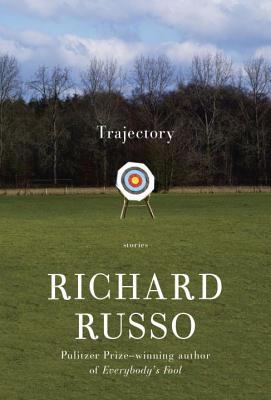
His terrific new collection of two novellas and two stories is called Trajectory.  Emotionally we are on familiar ground as his characters struggle to make sense of both the present and the ever-intruding past.  But these characters differ in that they are more firmly middle class types, teachers, retired professors, a high school principal, a writer/screenwriter, and in "Intervention", a seller of real estate recently diagnosed with cancer.  With Russo's characteristic warmth  the stories weave through webs of memory, silent long-held grudges, misunderstandings and complicated family issues. They each resolve uneasily, but with a hard earned bead of hope. 

 Here is an example of how he does it from near the end of the first story, “Horseman.”   A college instructor struggling with a student who plagiarized realizes it has brought up, again, a much examined period from her own student days.  Through the present struggle she starts to form a new perspective on her past.

In the other essay she'd find what Bellamy had noticed in hers, an absence.  An implied writer.  A shadow.  A ghost.  "But I do exist," she'd told him that day, however meekly, fearing he meant to convince her that even that wasn't true, when in reality he was merely urging her to discover that last elusive thing, a self worth being, worth becoming and finally worth revealing.  Yes, even though she knew what awaited her in those essays, she would at last read them.  She owed Bellamy that much.  He'd given her an assignment, and she intended to finish it.  After which, she suspected, he would haunt her no more.

In 1986 when Russo published Mohawk, Richard Ford, now 73, published his third novel, The Sportswriter. The title character's name was Frank Bascombe, and in him Ford found his most universal voice.
He wrote three other books with Bascombe at the center, and one of them, Independence Day, won both the Pulitzer Prize and the PEN/Faulkner Award. 

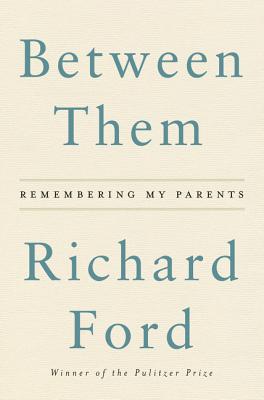
Ford's new book, Between Them, is a memoir of his parents.  "My Mother, In Memory" was written shortly after her death in 1981, and "Gone, Remembering My Father" is recent, finished a year ago, 55 years after his father's death in 1960.  These are beautiful haunted pieces.  They are filled with half-answered questions, surmise, and finally, a deep sense of mystery about these people who choose to have a child, him, quite late in the marriage.  Ford clearly loves his parents deeply and is grateful for the life he has that they provided, even indirectly.

He is a lover (as are many great writers) of the short stories of Anton Chekhov who in story after story validated the lives of ordinary men and women.  In this beautiful book, Richard Ford does the same for his parents.  He leaves an unsentimental record of two otherwise overlooked lives. Here is how he ends the memoir of his father,
But hardly an hour goes by on any day that I do not think something about my father.  Much of these things I've written here.  Some men have their fathers all their lives, grow up and become men within their father's orbit and sight.  My father did not experience this.  And I can imagine such a life, but only imagine it.  The novelist Michael Ondaatje wrote about his father that "...my loss was that I never spoke to him as adult."  Mine is the same--and also different-- inasmuch as had my father lived beyond his appointed time, I would likely never have written anything, so extensive would his influence over me have soon become.  And while not to have written anything would be a bearable loss-- we must all make the most of the lives we find--there would, however, not now be this slender record of my father, of his otherwise invisible joys and travails and of his virtue--qualities that merit notice in us all.  For his son, not to have  left this record would be a sad loss indeed.
These are books by two deeply humane and uncluttered writers.  They have been working at the craft for many years.  They do "make the most of the lives they find", and we are the better for them

Tuesday, May 2, 2017

Lessons in Shakespeare or "Will in the Bard-O"

There are new books this Spring focusing on three of Shakespeare's greatest creations: Sir John Falstaff, here principally observed through the lens of Henry IV, Parts 1 & 2; Hamlet, in this case both the character and the play, and Rosalind, the heroine of As You Like It.  All three books are hugely entertaining and deeply knowledgeable.  Collectively they serve as a great whistle wetter for the coming APT season. (There, you see what happens when writing about Shakespeare?  A delirious giddiness takes over and it seems perfectly apt to say "whistle wetters")


Harold Bloom, 87, long a champion of Falstaff, offers one more passionately argued paean to Sir John"s central importance in Shakespeare's creation of deeply human characters.  Bloom tells us he first fell for Falstaff at age 12, and it was nearly 20 years ago in his seminal book on Shakespeare, subtitled "The Invention of the Human" when he laid out many of the arguments found in this new slim volume.  He has sharpened his arguments, and the book serves as a wonderful introduction to both Henry IV and Henry V  as well.  Here is Bloom at his fiery best.  
"Falstaff is as bewildering as Hamlet, as infinitely varied as Cleopatra.  He can be apprehended but never fully comprehended.  There is no end to Falstaff.  His matrix is freedom but he dies for love."  You may not agree with all of Bloom's assertions in this book, but his erudition and passion for his subject are irresistible.

In 2012, Dominic Dromgoole, the former Artistic Director of Shakespeare's Globe Theatre in London, had the patently insane idea of taking a production of Hamlet to every country in the world.  Two years later, on the 450th anniversary of Shakespeare's birth, the journey began.  Over the next two years, culminating with a closing performance on the 400th anniversary of Shakespeare's death, his company of 12 actors and 4 stage managers performed in 197 countries only missing North Korea and Syria.  Dromgoole's wonderful book documents this seemingly impossible accomplishment.  We learn much about the play, more about the personalities and places and particular hardships, and crucially,  the belief in the power of a cleanly told and vivid story.  Here is Dromgoole after watching the final performance before the actors departed,


The show was there, the story was told, and it had a gracious modesty in  world.  Too great a immediate success would have induced a grandiosity which would have been a nightmare to tour.  'See, see how great we are' is not an attitude to take on the road - it's not an attitude for anything really...... The show was not perfect, but it worked.  It told the story, it carried the language and delivered it, and it presented the life within the story.  This is not always what people mean by theatre these days.  There is a difference between a car that works, and an exploding car with balloons on it.  A car that works ferries people from A to Z, conveying them from where they begin to a different place, and along the way it shows them scenery, whether beautiful, sad or strange.  A lot of theatre these days seems to be watching a car festooned with balloons explode, then bursting into applause and waiting  for a blogger to deconstruct the event.  Having been taken nowhere.  Our show didn't dazzle or explode, but it worked.  And it felt ready to wander.

The final book is a biography of a fictional character.  Rosalind is one of the greatest heroines in the English language and in her 417 year life span to date she has inspired many other brave, articulate and passionate fictional offspring.  She is wonderfully complex, playful, deeply emotional, highly skilled verbally, and full of intellect and longing. It is the longest woman's part in Shakespeare, and one that every serious Shakespearean actress hungers for.

Angela Thirlwell blends sharp scholarship with a Bloom-like love of Rosalind to create a memorable mix of theatre history and passionate exploration of both the role and actresses who have played her.  In 1962 as an early teen Thirlwell saw Vanessa Redgrave play the part and fell in love with both the character and the play.  Over all the subsequent years she has seen many actresses take Rosalind on and interviews many of them.  This gives the book an engaged energy of performance that makes it different from other similar studies.  On page two of her Prologue Thirlwell lets us know, deliciously, what will follow.

I love Rosalind because she is merry and mischievous, impetuous, empowering and brave.  Her play is about love.  It's for everyone and anyone who has ever loved, either unrequitedly or to joyous fulfillment.  Every kind of love is in this play, from carnal to divine: not only heterosexual love, but also homoerotic love, the love between friends, between women, love across generations, brotherly love and  sibling rivalry, the love between parents and children.  Rosalind faces up to love inside out and it spectre of rejection that all lovers fear. 

Taken together the three books are a besotted graduate seminar in Shakespeare and so much more.  Don't be late for class!
          

Tuesday, March 28, 2017

Exit West

Mohsin Hamid's fourth novel, Exit West, is superbly written and filled with surprises.  The biggest is Hamid's tone of insistent optimism.  The novel concerns mass migration from places in the South or East blasted by unstable and volatile politics or environmental decay to places of seeming stability in the West.  His protagonists, Nadia and Saeed, who meet and fall in love in an unnamed Asian city not unlike Lahore, Pakistan where Hamid was born, and now resides, make the excruciating decision to migrate.  Their journey leads from Greece to London, and finally to Marin County in California.  This is not a book of arduous journeys across great distances.  Hamid focuses on the circumstances leading to the decision to go, and the new life upon arrival.  One of the book's many wonders is his creation of mysterious "black doors" which are discovered in odd places in these desolate cities.  Find one and venture through it, and you are instantly in another place.

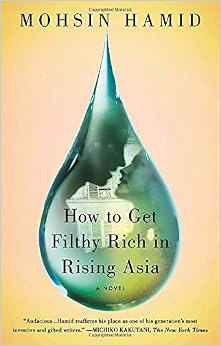
Hamid presents Nadia and Saeed with compassion and understanding.  Theirs is a small story which keeps expanding to encompass all the world.  Novel by novel Hamid's generosity toward his characters has grown. His last book, How to Get Filthy Rich in Rising Asiain the guise of a self-help manual tells of two people ("the man" and "the pretty girl") who start life with nothing and claw and force their way to respectability and comfort.  The book encompasses the long arc of both lives in only 200 pages.  The final scene has the man in a hospital, dying, and he is visited by the ghost of the "pretty girl". Here is how it ends

She is here.  And she comes to you, and she does not speak, and the others do not notice her, and she takes your hand, and you ready yourself to die, eyes open, aware this is all an illusion, a last aroma cast up by the chemical stew that is your brain, which will soon cease to function, and there will be nothing, and you are ready, ready to die well, ready to die like a man, like a woman, like a human, for despite all else you have loved, you have loved your father and your mother and your brother and your sister and your son and, yes, your ex-wife, and you have loved the pretty girl, you have been beyond yourself, and so you have courage, and you have dignity, and you have calmness in the face of terror, and awe, and the pretty girl holds your  hand, and you contain her, and this book, and me writing it, and I too contain you, who may not yet even be born, you inside me inside you, though not in a creepy way, and so may you, may I, may we, so may all of us confront the end.

It takes away your breath.  It is a remarkably tender and magical way to conclude, and it opened  Exit West.
Hamid's heart to a new path in his writing, a path which lead to
In a recent interview Hamid said,

I understand that people are afraid of migrants.  If you are in a wealthy country,it's understandable that you might fear the arrival of lots of people from far away.  But that fear is like racism: it's understandable, but it needs to be countered, diminished, resisted.  People are going to move in vast numbers in the coming decades and centuries.  Sea levels will rise, weather patterns will change, and billions will move.  We need to figure out how to build a vision for this coming reality that isn't a disaster, that is humane and even inspiring.

While Exit West does not presume to build this vision, it does, through its humane storytelling, begin to mitigate our fears of the other.  Hamid's optimism and resilience provide hope and a sense of shared responsibility in this too quickly changing world.  This is a beautiful and moving book.  Read it, and then pass it to a friend.


Thursday, March 23, 2017

On All Grown Up

All Grown Up by Jami Attenberg

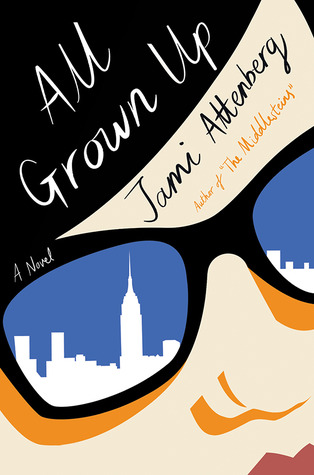
Jami Attenberg's (The Middlesteins) short sharp novel of a woman about to turn 40 is funny and smart.  Her protagonist, Andrea Bern, is single, childless, not in any sort of sustaining love relationship, and works at a job that she doesn't much like but is good at.  Over twenty time-skipping chapters we learn the many layers of life experience that have shaped Andrea from childhood to the present.  I admit, particularly in the opening chapters, to an impatience with Andrea and her  sometimes willful selfishness.  But this book reveals many of the conundrums women now face in America trying to simply "have a life" instead of striving  to "have it all".  It also sheds a harsh-- and often fiercely comic --light on women of all ages dealing with predatory or self-absorbed men.

I started this book (it is only 200 pages long) a couple of weeks ago and had to set it aside briefly.  I finished the last 130 pages in one gulp on a plane flight, and at the book's conclusion tears streamed from my eyes.  It gathers potent weight about life's choices, and I was rooting hard for Andrea through my tears.  Oddly, the very next morning as I walked my dog while listening to Morning Edition, Attenberg was interviewed (listen to it HERE) and said the following,
"I like the idea of somebody buying it in an airport on one end of a trip, and then finishing it by the end of the trip--and sort of sobbing on the plane too, that would be a little fantasy of mine as well."

Happy to complete the circle for you, Jami.  Thanks for the terrific book!

Wednesday, February 15, 2017

Ali Smith's Autumn


In Ali Smith's wonderful book Artful (2013), based on a series of lectures she gave at Oxford, which combines fiction and the essay form in an astonishing and complex discussion of art and storytelling, she writes the following

 Books need time to dawn on us, it takes time to understand what makes them, structurally, in thematic resonance, in afterthought, and always in correspondence with the books which came before them, because books are produced by books more than by writers; they're a result of all the books that went before them. Great books are adaptable; they alter with us as they alter in life, they renew themselves as we change and re-read them at different times in our lives.  You can't step into the same story twice-- or maybe it's that stories, books, art can't step into the same person twice, maybe it's that they allow for our mutability, are ready for us at all times, and maybe it's this adaptability, regardless of time, that makes them art, because real art (as opposed to more transient art, which is real too, just for less time) will hold us at all our different ages like it held all the people before us and will hold all the people after us, in an elasticity and  with a generosity that allow for all our comings and goings.  Because come and go we will, and in that order.

I share this for two reasons.  First, because it is emblematic of her cast of mind, of her subtle understanding of complexities, of her grasp of both art and the human heart, and of her humor.  Second, to grieve.  I know her idea to be correct, and at my age (late-middle) I grieve that I will have fewer opportunities than lucky younger readers, to re-appreciate and wonder at each repeat read of her new novel, Autumn.

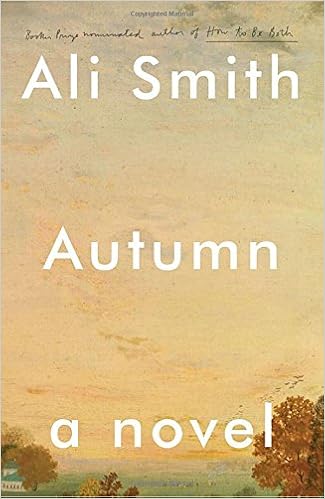
Smith wrote it last summer after the Brexit vote in the UK.  Autumn, which travels back and forth through time, has a feisty anger in its present-day scenes.  People for or against Brexit are stunned and wonder what the future might hold.  It is an understatement to say it resonates here as well. But the politics, ripe as they are, play a minor roll. 

This is a book about an unusual and profoundly tender friendship between 32-year-old (in the present scenes) Elisabeth, and Daniel, her former next-door neighbor and sometime babysitter, who in the present scenes is 101.  It is a book of memory, forgetting, music, art history, love, family, poverty, a book about so many things, but always about connection and a hunger for life whatever it might have in store for each of us.

As it slides through time and we learn bits of each person's story, their disappointments, their tiny triumphs, the unbearable richness of each and any life rises up and catches our hearts over and over.  Sad, funny, informative, insightful and deeply moving, it is an astonishing achievement.    It is the beginning of a planned quartet of novels named for the seasons.  It is difficult to imagine the other seasons having the abundance of Autumn, but I can hardly wait to find out.

You can read a NY Times Review HERE, and an interview with Ali Smith about her reading habits HERE.

Thanks, Obama